Optical-Robust Geometry Estimation

OptiGeo: Efficient Monocular Geometry for Embodied Perception in Optically Challenging Scenes

Redefining transparent and reflective depth estimation with a lightweight, high-precision framework for edge deployment.

1The University of Hong Kong 2Voyager Research, Didi Chuxing 3Southern University of Science and Technology
*Equal Contribution Corresponding Author

Abstract

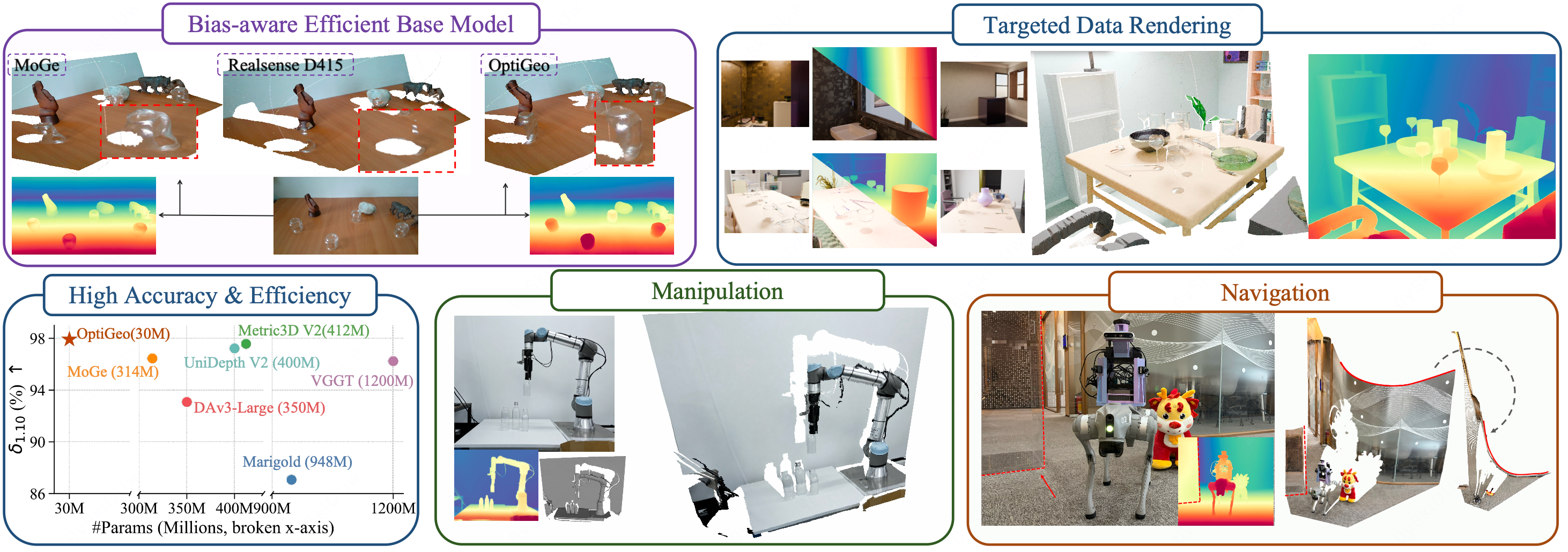
OptiGeo teaser overview

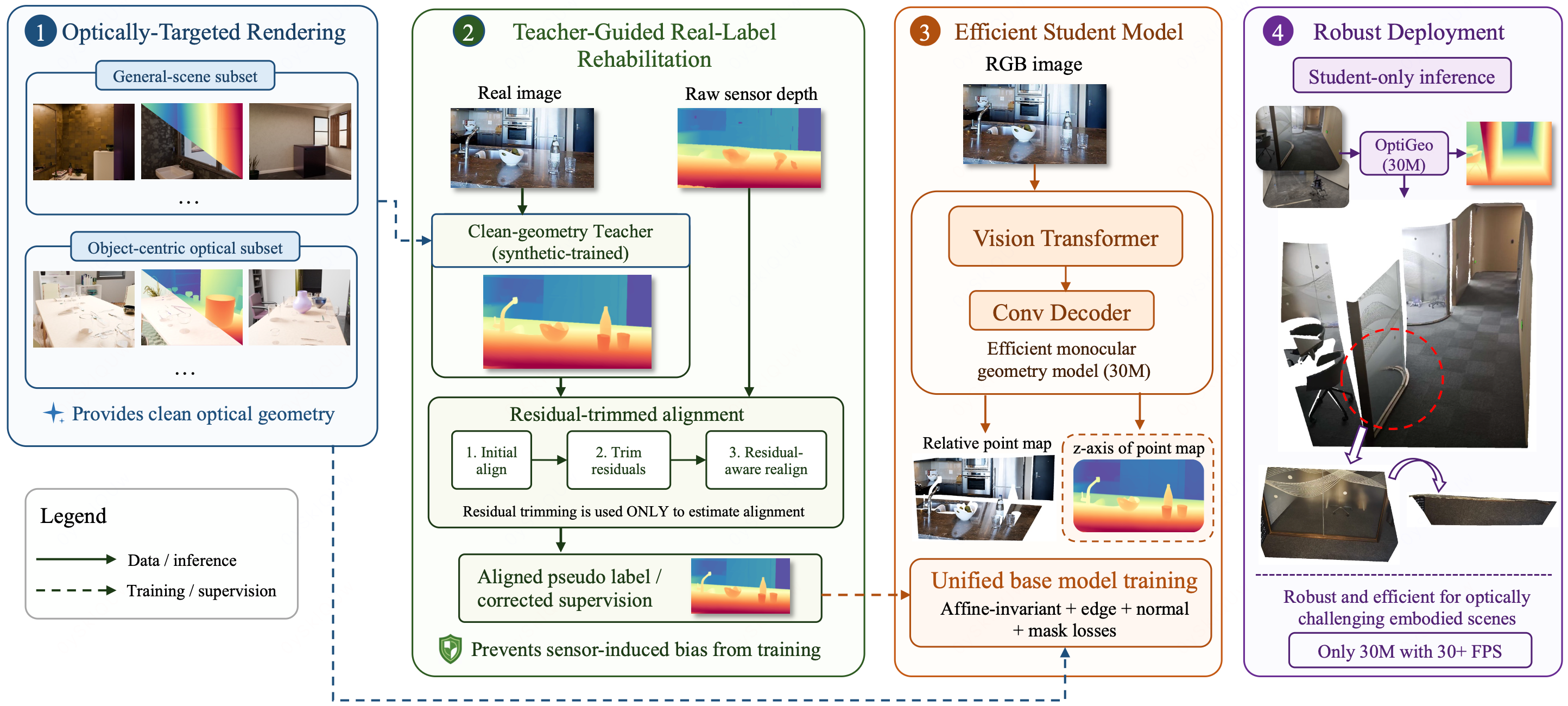
Monocular depth estimation has achieved strong open-domain generalization, yet reliable robotic deployment remains difficult in transparent, reflective, and specular environments, where depth sensors often produce missing or biased depth. Existing methods often handle such optical failures with scene-specific preprocessing, auxiliary modules, or post-hoc fine-tuning. While effective in constrained settings, these designs increase architectural redundancy and can over-specialize general geometry models to narrow optical scenarios. We revisit this problem as a localized failure mode within base-model training and identify sensor-induced supervision bias as a key bottleneck: models inherit sensor failure patterns from biased real-depth supervision in optically challenging regions. We then introduce OptiGeo, a bias-aware training framework that rehabilitates biased real supervision using a clean-geometry teacher and residual-trimmed alignment. We redefine transparency-targeted rendering as a compact source of clean optical geometry, rather than a large domain-specific fine-tuning set. With only a small targeted rendering set, OptiGeo learns the geometric structure of transparent objects and regions, correcting local geometry distortions that real sensors cannot reliably supervise. Despite only 30M parameters, OptiGeo outperforms substantially larger 300M-scale monocular models and billion-scale multi-view baselines on transparent-scene benchmarks, while remaining competitive on general zero-shot depth and boundary sharpness. Real-world navigation cases further validate its practicality as an efficient perception module in optically challenging scenes.
Empirical Study

3.1

How Optical Bias Enters Base-Model Training

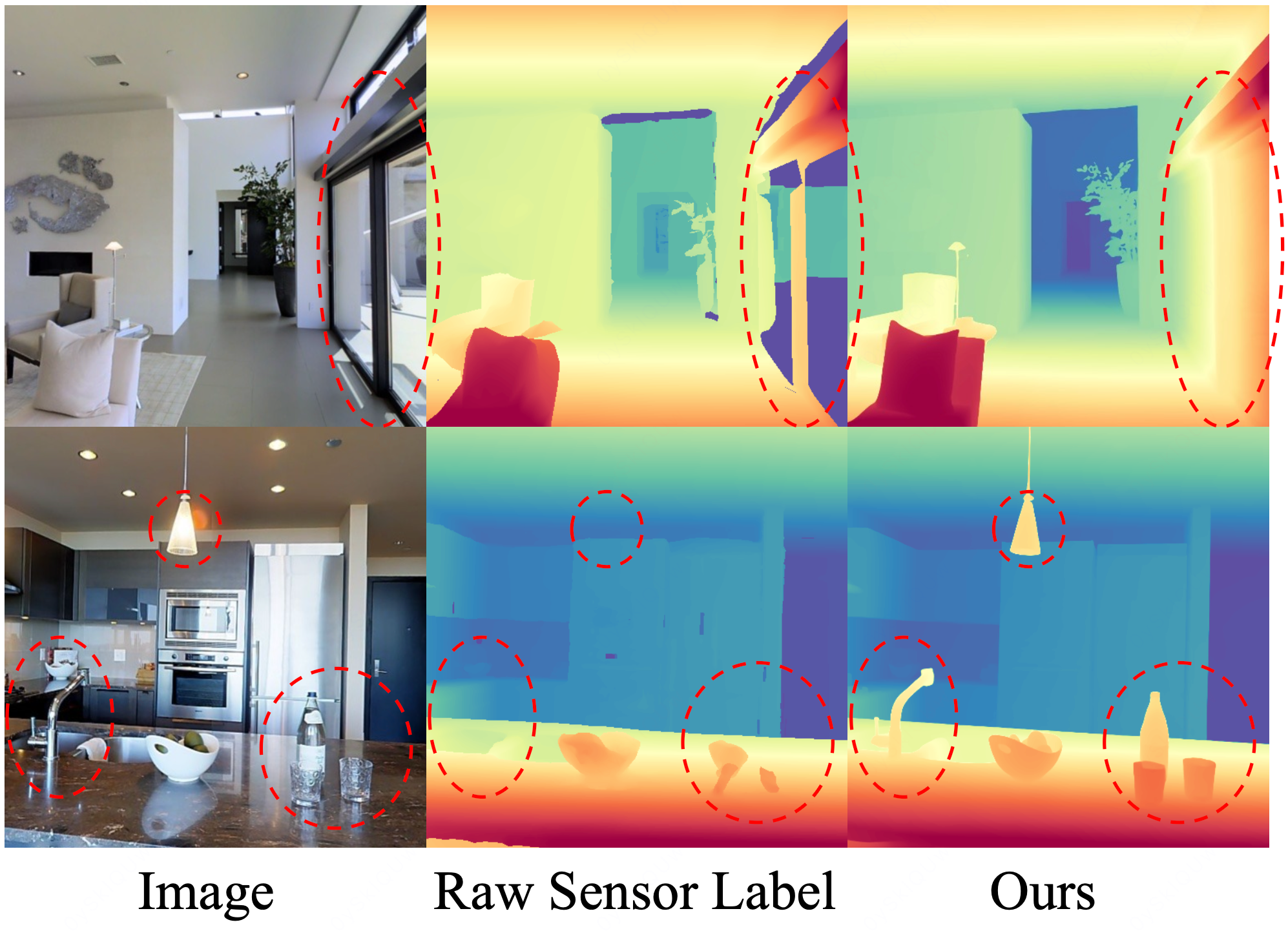
Empirical analysis of how optical bias enters base-model training

Real RGB-D supervision can look valid while still being wrong in transparent and reflective regions. Background leakage, missing object depth, and distorted specular measurements are absorbed as training labels, causing general monocular geometry models to inherit sensor failure patterns.

3.2

Are Optical Challenges a Separate Depth Task?

The failure is localized rather than a whole-image breakdown. Full-image results on ClearGrasp Real show that strong base geometry can already recover scene-level structure, while the remaining difficulty concentrates around optical regions.

Method Params AbsRel ↓ δ1.05
DAv3-Large 350M 2.94 85.6
VGGT 1.2B 1.98 91.9
OptiGeo-Teacher 940M 1.46 94.6
3.3

What Role Should Transparency-Targeted Data Play?

Transparency-targeted rendering data for clean optical geometry

Transparency-targeted data should not act as a large domain-specific fine-tuning set. Instead, a compact rendering set supplies clean local optical geometry for glassware, refractive boundaries, and occlusion structures that real sensors cannot reliably annotate.

Bias-Aware Geometry Training

OptiGeo training pipeline

OptiGeo pipeline. A clean-geometry teacher is trained only on synthetic supervision to avoid inheriting real sensor artifacts. For real images, residual-trimmed alignment calibrates the teacher to reliable sensor pixels and suppresses high-residual regions that often correspond to transparent or reflective failures. Corrected real labels and clean rendered samples then train a compact 30M student for efficient feed-forward inference.

Results and Ablations

30M parameters
30.52 FPS
0.42GB peak memory

Numerical Ablations

Controlled ablations are trained on two subsets, ARKitScenes and Hypersim, using 8 NVIDIA H20 GPUs. Residual-trimmed real-label rehabilitation consistently improves transparent-scene accuracy, generalization, and boundary sharpness.

ClearGrasp Real

Variant AbsRel ↓ RMSE ↓ MAE ↓ δ1
Base 0.0274 28.93 18.95 99.0
+ Refine 0.0253 24.71 16.92 99.6
+ Trim + Refine 0.0224 22.79 15.41 99.7

Sensitivity to Trimming Ratio τ

τ AbsRel ↓ SiLog ↓ RMSE ↓ MAE ↓ δ1
0 0.0253 3.5815 24.71 16.92 99.6
0.05 0.0251 3.5248 24.63 16.89 99.7
0.10 0.0224 3.1799 22.79 15.41 99.7
0.15 0.0272 3.7743 27.23 18.68 99.6
0.20 0.0254 3.4832 25.55 17.70 99.7
0.30 0.0251 3.5165 25.14 17.04 99.7

Generalization Mean

Variant AbsRel ↓ δ1
Base 8.031 91.71
+ Refine 7.951 91.76
+ Trim + Refine 7.939 91.80

Boundary F1

Variant iBims-1 HAMMER Mean
Base 12.07 2.39 7.23
+ Refine 13.77 2.98 8.37
+ Trim + Refine 14.33 3.93 9.13

Target Rendering Ablation

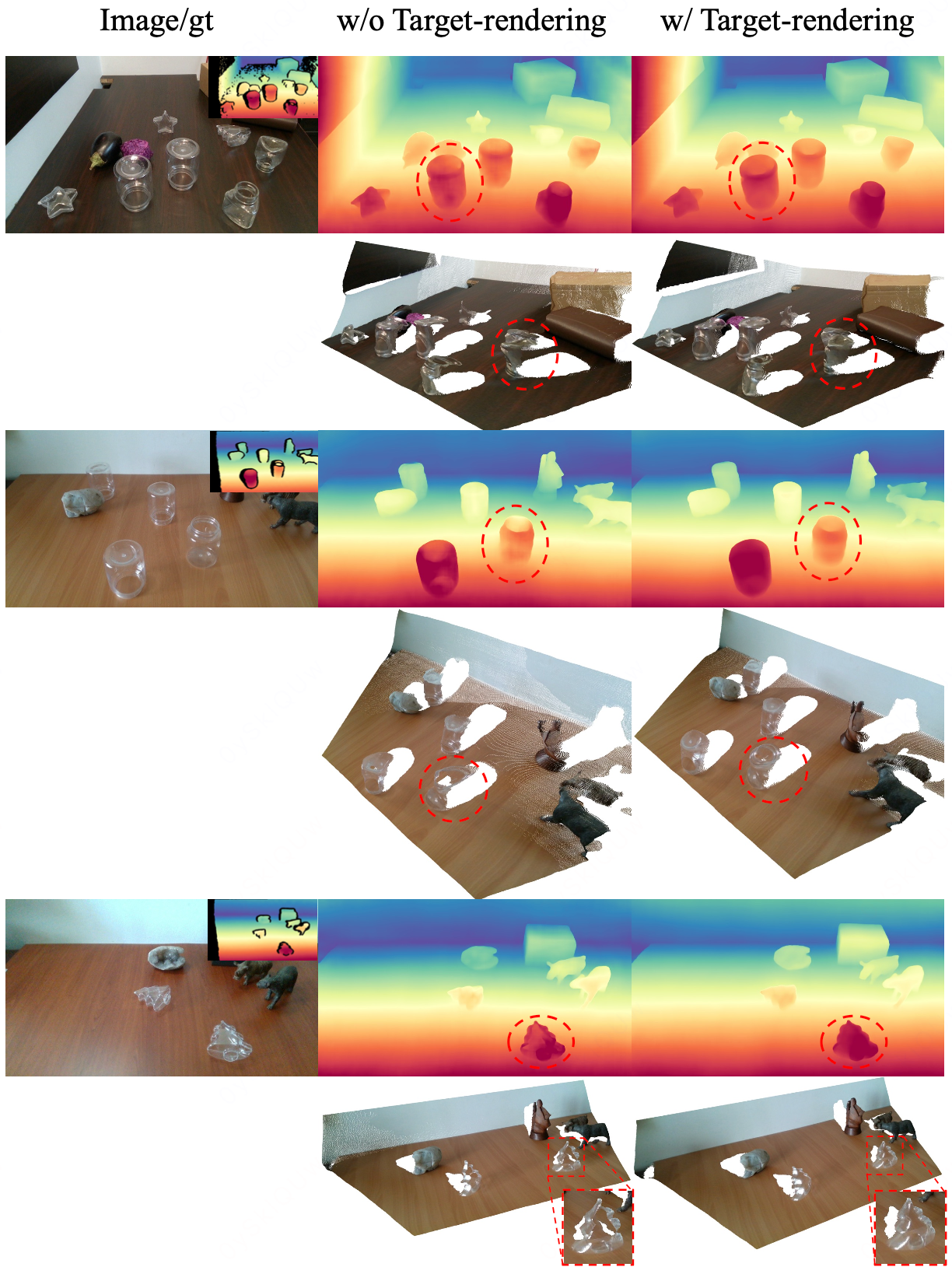
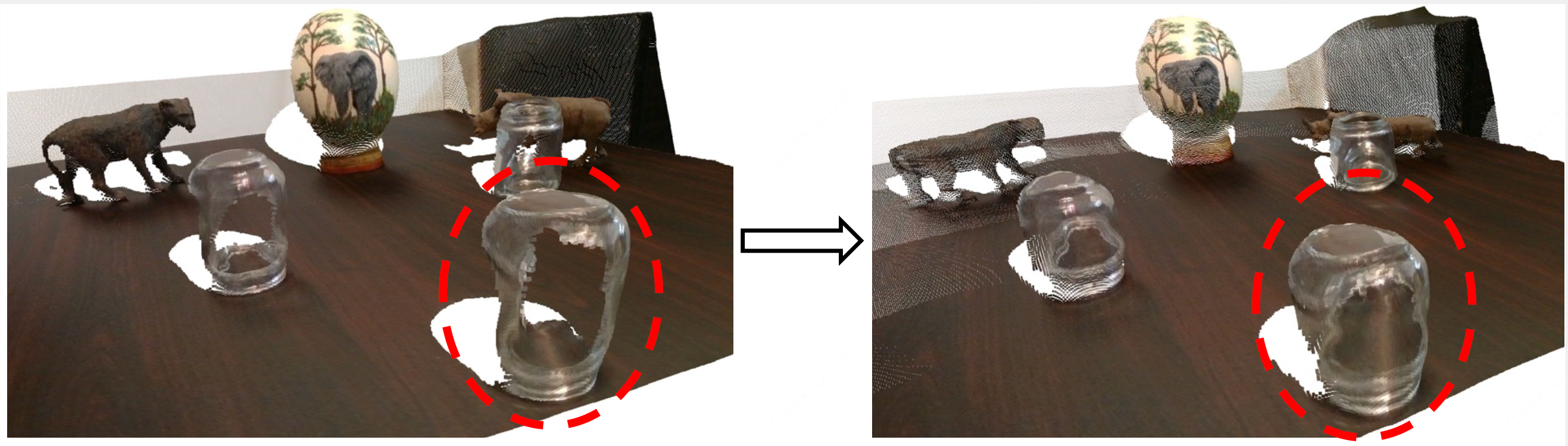
Targeted rendering supplies clean local optical geometry, recovering more complete transparent objects and sharper point-map structures.

Target rendering ablation comparing results with and without targeted rendering

Real-World Embodied Scenes

OptiGeo real-world optical scene result
OptiGeo real-world navigation scene result

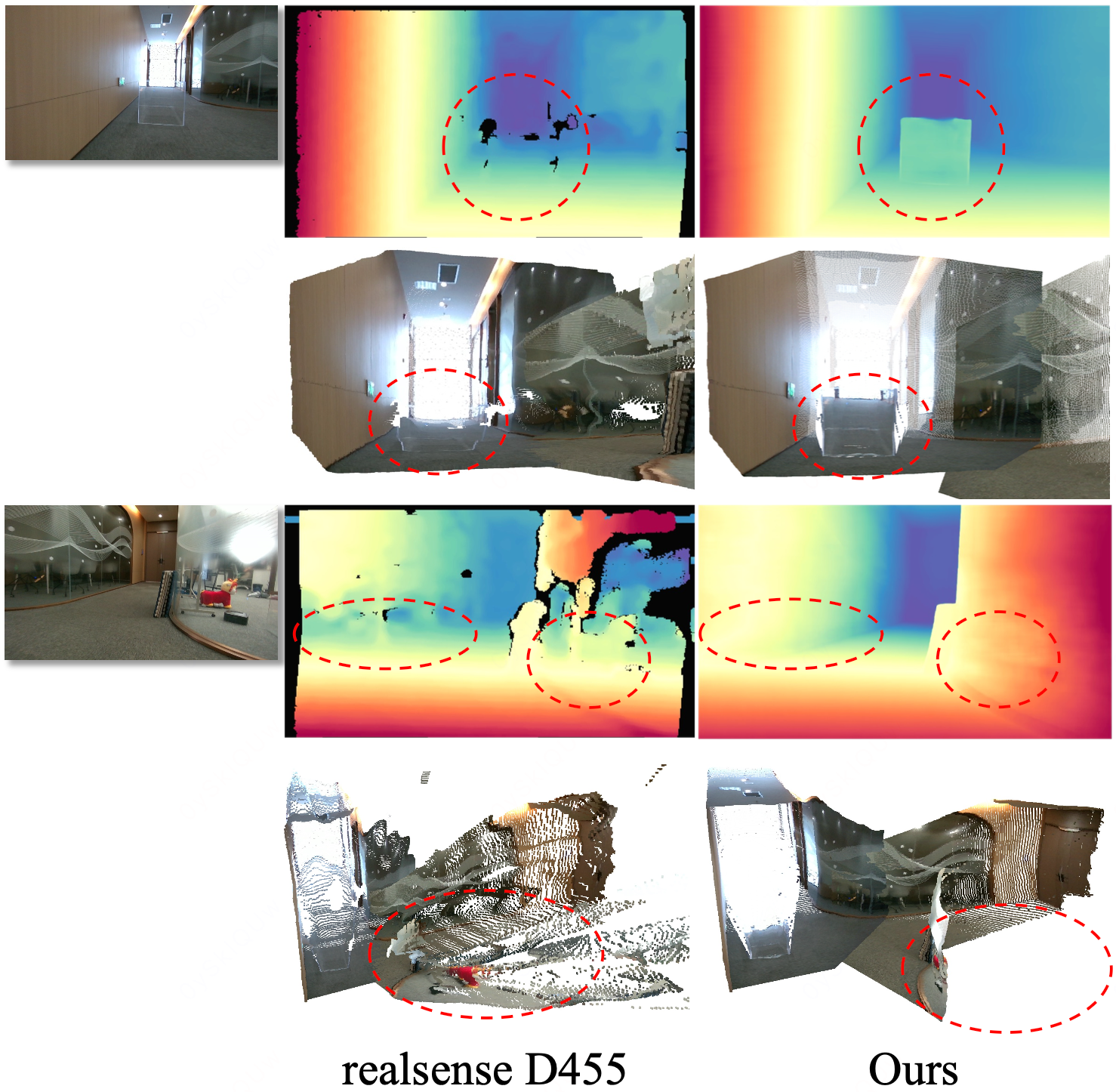
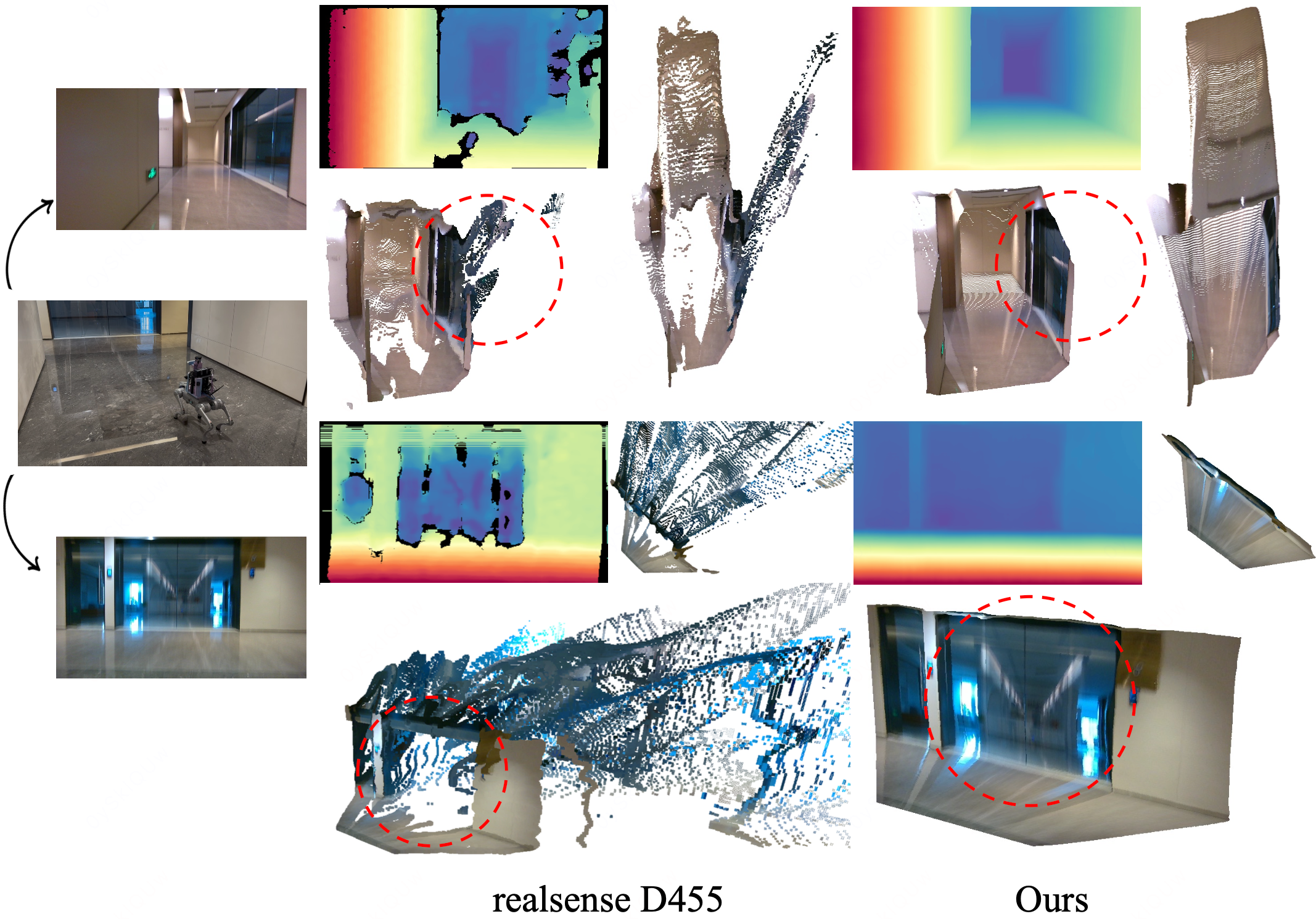
Downstream perception. In real transparent and reflective scenes, OptiGeo recovers more coherent object and surrounding geometry, supporting embodied agents that must reason about glass doors, mirrors, transparent containers, and other visually deceptive obstacles.

BibTeX

@misc{liu2026optigeo,
      title={OptiGeo: Efficient Monocular Geometry for Embodied Perception in Optically Challenging Scenes}, 
      author={Muxin Liu and Tianbo Liu and Jing Xia and Xiaoyang Lyu and Xiaoshan Wu and Bo Wang and Peng Dai and Zhongrui Wang and Shaoshuai Shi and Xiaojuan Qi},
      year={2026},
      eprint={2608.29881},
      archivePrefix={arXiv},
      primaryClass={cs.CV},
      url={https://arxiv.org/abs/2608.29881}, 
}